THERMAL SURVEYS & INSPECTIONS
Thermal Imaging Surveys & Inspections
Proven track record in commercial projects
Focused on businesses and public sector
Fully qualified, DBS checked and continuously trained
Work to the highest standards and current regulations
Reliable maintenance and responsive support
OVERVIEW
Thermal Imaging for Proactive Inspection & Fault Investigation
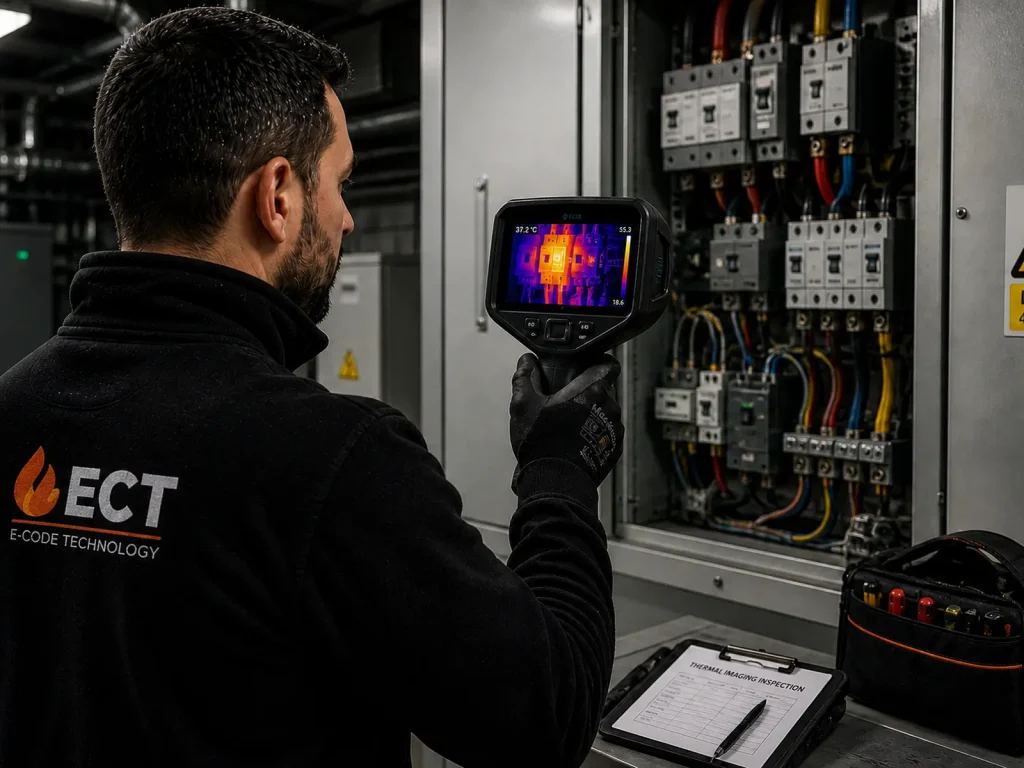
Thermal imaging provides a non-contact way to compare surface temperatures and identify patterns that may justify closer investigation. In electrical equipment, unusual heating can sometimes indicate loose connections, imbalance, overloaded components or developing faults that are not obvious during a simple visual inspection.
ECT provides commercial thermal surveys and inspection support, recording relevant anomalies and interpreting them in context. Thermography is used as an additional diagnostic tool rather than a diagnosis on its own, with further electrical or specialist investigation recommended where appropriate so facilities teams can prioritise follow-up work on a sensible basis.
OUR CAPABILITIES
Thermal Surveys, Electrical Inspection & Reporting
Thermal imaging is particularly useful as part of planned condition monitoring or when an organisation wants additional information about equipment showing signs of stress or repeated problems.
INSPECTION TECHNOLOGY
Thermal Imaging Equipment & Practical Interpretation
A useful thermographic survey depends on more than pointing a camera at equipment. Load, access, emissivity, reflections and the surrounding environment can affect what the image shows, so findings need to be interpreted carefully.

Need Support with Thermal Imaging?
Discuss thermal imaging surveys and inspections with E-Code Technology Ltd. Call 01684 252014 or email [email protected] to outline your site, equipment and the areas you would like inspected.
APPLICATIONS
Thermal Imaging for Electrical & Critical Building Systems
Thermal imaging can be useful around electrical distribution boards, switchgear, connections and other suitable equipment in offices, industrial premises, data environments, public buildings and multi-site estates. It can support preventive maintenance programmes as well as targeted fault investigations.
The technique does not replace electrical testing or engineering judgement. Its value is in identifying heat patterns that help direct closer inspection before a problem becomes more obvious or disruptive.
WHY ECT
Thermal Imaging Interpreted as Part of the Technical Picture
ECT combines thermal imaging with broader experience of commercial electrical-style control and life-safety systems. That encourages a practical interpretation of what is visible rather than treating every warmer component as a defect.
Findings are communicated clearly, including where the image suggests further electrical investigation rather than an immediate conclusion. This is particularly useful for facilities teams planning preventive maintenance or prioritising remedial work.

Frequently Asked Questions
What can thermal imaging detect?
Thermal imaging can highlight unusual surface-temperature patterns that may be associated with electrical loading, poor connections, component stress or other conditions. It identifies areas for investigation rather than proving the cause on its own.
Does equipment need to be operating during the survey?
For many electrical thermography applications, representative load is important because temperature patterns are more useful when the equipment is operating normally. The exact survey conditions depend on the equipment.
Is thermal imaging a replacement for electrical testing?
No. Thermography is a useful condition-monitoring and diagnostic tool, but identified anomalies may require further electrical inspection or testing to establish the cause.
Will I receive thermal images and findings?
Yes. The survey can include relevant thermal images and a practical record of anomalies or areas recommended for further attention.
Can you survey several electrical panels or sites?
Yes. Surveys can be planned across multiple panels, buildings or sites where access and operating conditions can be coordinated.
TELL US ABOUT YOUR REQUIREMENTS
Tell us briefly about your site, existing system or planned works and we’ll get back to you to discuss the next steps.
Thermal Imaging Across the Midlands & Surrounding Regions
Thermal Imaging Across the Midlands & Surrounding Regions
ECT provides commercial thermal-imaging surveys across Worcestershire, the Midlands, Herefordshire, Gloucestershire, South Wales and surrounding areas, with multi-site and larger survey programmes available by agreement.